Most enterprise software already delivers value; the challenge is proving it consistently enough to get paid for it.
Most enterprise software companies have the same hidden problem: the product is genuinely valuable, but the sales process can't prove it. Deals fizzle not because the technology failed, but because no one built the business case, no one manufactured alignment at the executive level, and no one could tell the difference between a prospect who was moving and one who was stalling.
The fix isn't a better CRM; CRMs store activity, they don't provide judgment. What changes outcomes is a system that reasons — one that interprets the specific fact pattern of each deal against accumulated sales knowledge and tells the rep what to do next.
That's what an operational reasoning system does: it connects proven methodology to the deal at hand, in real time, without requiring a senior leader to be in every conversation.
Three ways it directly closes the gap:
-
Business Case Automation — The system converts discovery context into a structured, CFO-ready business case in minutes. The financial conversation happens on every deal, not just the ones where a rep had time to build a deck. This alone narrows the competitive field by 60% — only two of five vendors ever speak the language of the decision-maker.
-
Behavioral Deal Scoring (WARD) — Progress is measured against five sequential customer-validated markers, not rep sentiment. When all five are checked, forecast confidence reaches ~90%. Boards stop hearing deal stories and start asking the right question: why aren't these boxes getting checked?
-
Institutional Memory Compounding — Every interaction, override, and outcome is captured and fed back into the system. New reps ramp in weeks, not months. When a CRO leaves, the playbook stays. The system gets smarter with every deal — accumulating judgment no individual sales leader can replicate at scale.
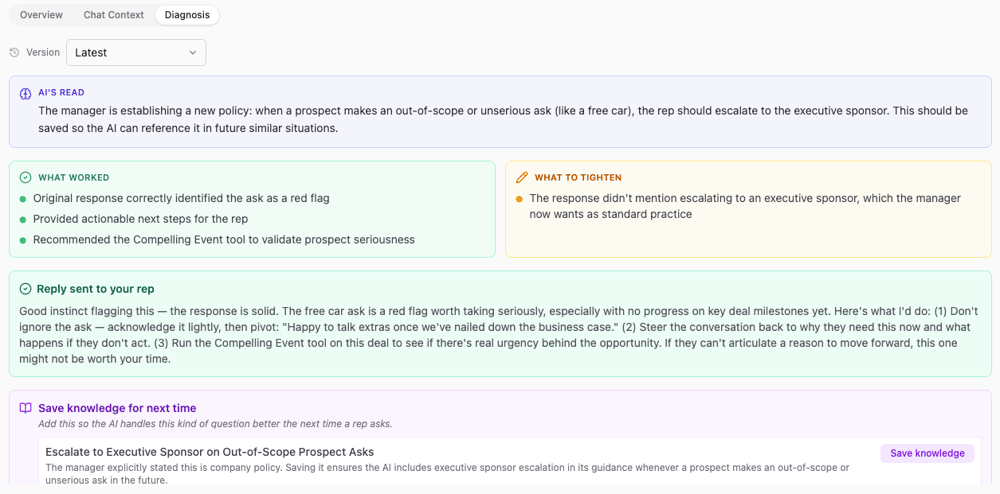 The above screen reflects a sales rep and CRO interaction that is becoming the new agreed-upon approach to handling a certain fact pattern. All chat-based.
The compounding loop is straightforward: more usage generates more sales traces, more traces improve judgment, better judgment drives better outcomes, and better outcomes drive more usage. Unlike traditional software, the system appreciates in value the longer it runs.
For portfolio companies where revenue is underperforming relative to product quality, the question isn't whether the software is good enough; it almost always is — the question is whether the sales process can prove it, and whether that proof survives the next leadership transition.
An operational reasoning system is how it does — visit www.moicpartners.com to see how operational reasoning helps enterprise software companies close the gap between product value and revenue.


.jpeg?width=352&name=Photo%20-%20shutterstock_1972218197%20(small).jpeg)