
Know when to walk away
It has happened far too often: a sales rep learned after a seven-month sales cycle that he/she had lost the deal. If the deal evaporated due to some external event, such as a merger or an economic event that could not have been expected, that would be understandable. But to just lose is difficult to accept.
After all, would you stay in for a seventh card in Seven Card Stud if you knew you had only a pair of tens and another player was showing three aces? Of course not—you’d fold as soon as it became apparent that you couldn’t win.
Such is the same for enterprise software sales. In this case, several obvious questions come to mind, such as:
-
Did we get acknowledgement from the decision maker that our product differentiation was unique and valuable to the them?
-
Were we truly calling on the decision maker, or were we shielded from him/her?
-
Did the decision maker negotiate and validate our business case driven by our unique capabilities?
-
Did we demo last?
The practical reality is that sales reps often get so emotionally invested in deals, they defend sales process omissions and perceived short cuts in an effort to win an unwinnable deal. In their words, salespeople will do almost anything to keep from walking away from a big deal that they believe they should win, even when they are fed clues that should lead to walking away from a sure loss.
The other lingering question is “Where was the sales leader during these seven months?" The sales leader should have challenged the sales rep early and often regarding whether the opportunity was meeting the evidence-based requirements defined in COMPASS.
COMPASS makes those challenges easier to surface. Its Knowledge Graph connects what the organization knows about an opportunity — decision-maker access, validated differentiation, business-case support, deal history and other critical evidence — so warning signs are visible before months are invested in a deal that cannot be won.
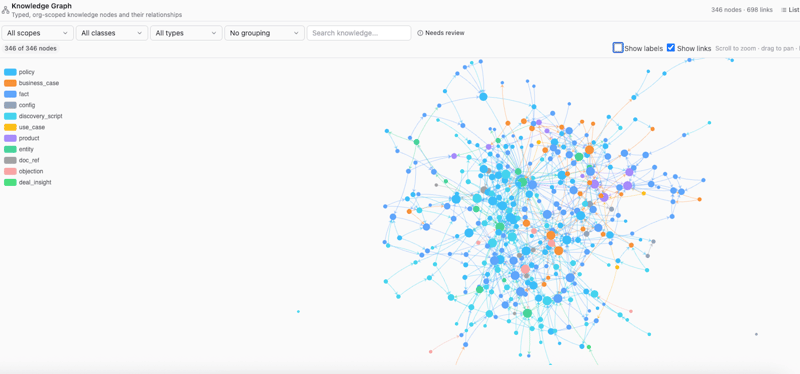 COMPASS Knowledge Graph connects opportunity evidence, making gaps and warning signs easier to identify.
In this case, the sales rep allowed his/her coach to shield him/her from the decision maker. Don’t forget, only one vendor gets an audience with the decision maker and since we didn’t get to the decision maker, it’s safe to assume that our opposition did and is positioning to win.
This should have been seen as a clue that the deal was lost within the first 30 days, instead of waiting seven months to hear the news. Once the sales rep was unsuccessful getting to the decision maker, he/she had two choices: reaffirm our unique value and business case with our coach in an effort to earn a meeting with the decision maker or walk away from the deal altogether. It was at this point that the deal was lost.
Our belief that we should win the deal is not a good enough reason to continue to pursue the deal; that belief is too subjective. Time is too valuable to waste it on deals that cannot be won.
Regardless, both the sales rep and the sales manager are complicit as it relates to poor execution when losing a deal after a seven month sales cycle. If your sales team struggles to walk away from bad deals, please reach out to dave@moicpartners.com or review COMPASS at moicpartners.com.