The fastest way to lose a deal is to demo before understanding the problem
For the entire 40+ years of my enterprise software experience, prospective enterprise software customers have pushed software companies for two things on the first call: price and to see a demo. As previously discussed, price is asked on the first call in order to disqualify vendors. The demo request, meanwhile, is used to commoditize software vendors based on their features without respect to the unique value of the features.
So why do software vendors "dash to the demo?" The answer is simple — software salespeople like to play show and tell, as they mistakenly feel that the features will sell the software, even without context. Software salespeople are so proud of their product features that they somehow feel that they will win the deal at the demo.
The practical reality is that deals are rarely won at the demo, but they can be lost at the demo. The losses are not because of solution engineers' demo skills; instead, it's because the demo is best leveraged as a proof statement; that the value promised from the business case can be realized through the software capabilities. However, when the demo is performed without understanding exactly which unique features are driving the valued expressed in the business case, the demo becomes merely a litany of independent features in a game of feature poker.
Instead, the customer needs to "earn" the demo by first explaining the business challenge the company is trying to address and verify the business case for addressing it. Once completed, allow the demo flow to be driven specifically by the unique features of the software and how those features address directly address the business challenge, which allow the software salesperson to quantify the value of how these specific features directly drive the business value addressed in the business case.
Alternatively, aimlessly showing features without a direct relationship to the specific business challenge can lead, at best, to a demo that will not lead to a sale. At worst, aimless demos present an opportunity cost to the software vendor inasmuch as the 10-20 hours spent preparing for an aimless detailed demo are 20-20 hours not spent focused on a demo that is tailored to reflect a business case that can lead to closing a deal.
This leads us to the core question: What should be the conversion rate from detailed demos to closed wins? I suggest that at least 65% of all detailed demos should close, because we shouldn't be doing detailed demos unless we have already identified our unique capabilities and those capabilities have been recognized by the customer to be both unique and valuable. Further, before we agree to a detailed demo, we should have validated the business case with the decision maker and learned the timing associated wanting to address the business value and the financial ramifications of not addressing the issue (aka the compelling event).
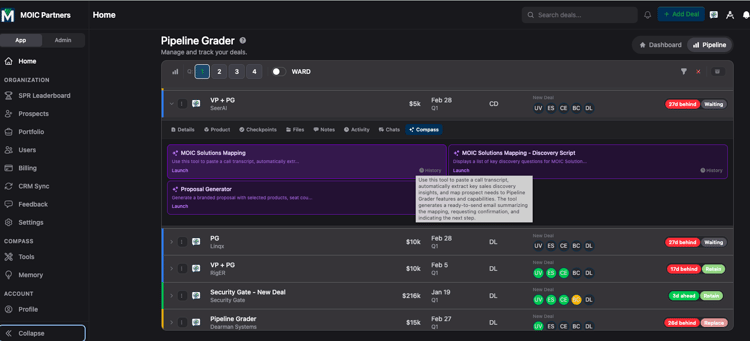
Once and only once these objective markers identified within MOIC Pipeline Grader have been satisfied, should we agree to do a detailed/custom demo and invest the time to do it properly. This disciplined approach (without taking shortcuts) will likely produce the desired 65% conversion rate of detailed demo to closed wins.
If your sales team struggles to convert at least 65% of its custom demo to closed deals, login to MOIC Pipeline Grader at www.moicpartners.com to develop the necessary sales discipline for consistent and predictable close rates.