Accelerating new-hire productivity transforms a routine operating expense into a measurable financial advantage.
Sales leaders have traditionally viewed the time required to bring a new salesperson up to full productivity as a necessary cost of doing business. Known as ramp-up, this is the period between hiring a salesperson and having that individual consistently perform at full sales quota. But what happens when we begin treating that period as a financial investment rather than simply an onboarding exercise? The economics become compelling.
RAMP (Rep Acceleration & Margin Performance) measures the financial benefit of accelerating new salesperson productivity while reducing the costs associated with unsuccessful hires. Consider a salesperson carrying a $600,000 annual quota with fully loaded annual compensation of $120,000. Assuming 50% productivity during ramp-up, reducing the time required to reach full productivity from six months to two months increases expected revenue production during the first six months from $150,000 to $250,000. That's an additional $100,000 in revenue per salesperson, a 67% improvement, without increasing quota or compensation.
But revenue acceleration is only half the equation. Faster ramp-up can also improve salesperson retention. A salesperson who spends six months struggling to build pipeline, close business, and earn commissions faces a greater risk of frustration and eventual departure. Conversely, a salesperson who becomes productive in two months experiences success sooner, earns commissions earlier, and develops greater confidence in their ability to perform. Earlier productivity creates the conditions for better retention, benefiting both the salesperson and the employer.
Assuming faster ramp-up reduces early salesperson turnover from 30% to 20%, the financial benefits become even more compelling. Combined with the reduction in unproductive compensation, the modeled cost of a failed hire falls from $55,000 to $35,000.
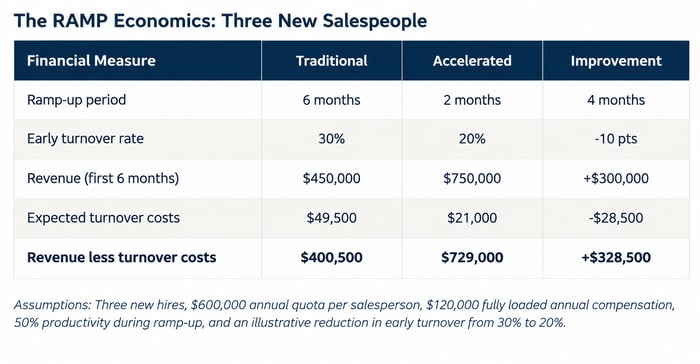
The result is an 82% improvement in six-month revenue less expected turnover costs, representing $328,500 in additional modeled financial contribution from hiring just three salespeople. Importantly, this improvement requires neither higher quotas nor additional headcount. It comes from making the existing investment in sales talent more productive while improving the likelihood that those investments remain with the company.
While RAMP is a simplified financial contribution measure rather than a complete accounting P&L, its implications extend well beyond sales enablement. Faster ramp-up accelerates revenue production, can improve employee retention, reduces the capital exposed to unsuccessful hires, and creates an opportunity to improve operating margins. Actual profitability will also depend on gross margins and other operating expenses.
The larger point is that salesperson ramp-up is not simply an HR or training metric. It is a capital efficiency metric. Organizations that systematically shorten the time between hiring and full productivity can create a repeatable financial advantage. And when that advantage is multiplied across successive hiring classes, RAMP becomes more than a measure of sales effectiveness. It becomes a contributor to growth, profitability, and ultimately enterprise value.
Operational Reasoning makes this possible. Compass is the Operational Reasoning system for sales where a committee is deciding.
Every month spent bringing a salesperson to full productivity has a measurable financial impact. Reducing that time isn't simply an operational improvement—it's an opportunity to accelerate revenue, reduce unnecessary costs, and strengthen the return on your investment in sales talent.
Ready to turn faster sales productivity into measurable financial results? Discover how Compass by MOIC helps sales leaders make better decisions, accelerate execution, and improve performance.


