
Buyers don't just buy growth — they buy how you grew.
Most SaaS leaders obsess over ARR growth. Twenty-five percent year-over-year feels strong. The Rule of 40 is green. The board is happy. But buyers aren't just buying your revenue — they're buying how you acquired it.
The Analogy Most Founders Miss
Think of your revenue like a house. Two homes, same square footage, same neighborhood. One was built on solid ground. One was built on fill. Both look identical from the street. The difference only shows up when the soil shifts — or when the inspector shows up.
Net new bookings are solid ground. Expansion and renewal have their place, but a business that derives 75% of its bookings from net new is structurally different from one at 50%. The inspector — your acquirer — knows this.
The Overlooked Driver: Revenue Quality Premium
At $5M ARR growing 25% annually with a 10% operating margin, your Rule of 40 score is 35 — which prices you at 6.4x roughly at exit.
But shift your net new booking mix from 50% to 75%, and the market applies a quality premium. Research on revenue mix and exit multiple variance shows this shift commands approximately +0.5× on the multiple — a seemingly small number with a large consequence.
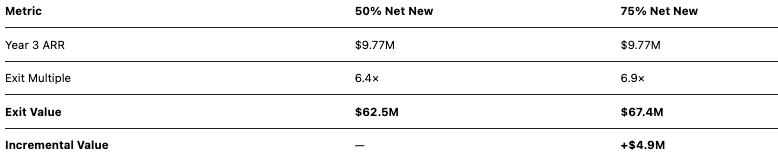
Same growth rate. Same margin. $4.9 million more at the table.
Tie It to Money — Starting Now
At a 33% IRR requirement, that $4.9M in future exit value is worth ~$2.08M today.
Spread across a 36-month term, that's $57,900 per month in justified investment — right now — to drive the mix shift that creates it.
That isn't a software cost. That's a capital allocation decision. The question isn't whether you can afford to fix your pipeline quality. It's whether you can afford not to.
The Mechanism: Pipeline Discipline at the Source
Booking mix isn't a marketing problem. It's a pipeline execution problem — and it starts with what your reps are actually working, how deals are being graded, and whether your process distinguishes net new opportunities from expansion noise.
That's exactly what Pipeline Grader is built to do — use the same methods that some of the largest software companies used to achieve their success. Know what to do and when to do it.

.jpeg?width=352&name=Photo%20-%20shutterstock_1972218197%20(small).jpeg)