
Your pipeline lives in your CRM; your wins don’t.
Everybody Lives in Their CRM
HubSpot, Salesforce, Dynamics — they're great at what they do: storing information. Contacts, activities, stages, notes. Nobody's arguing against that.
But storing information and winning a deal are not the same thing.
The Filing Cabinet vs. The War Room
A CRM is a filing cabinet — organized, reliable, searchable. But a filing cabinet has never closed a deal. When it's time for strategy, you go to the war room.
A rep we work with put it plainly:
"I work in HubSpot a lot. But when it comes to my strategic deals, I'm in MOIC. I use MOIC to run my deals through the 5 markers to know what I need and when I need it, build out my business case — major reason why — and everything in between to help push my deal to close."
She didn't abandon HubSpot. But when the stakes are high, she goes to her war room.
The 5 Markers
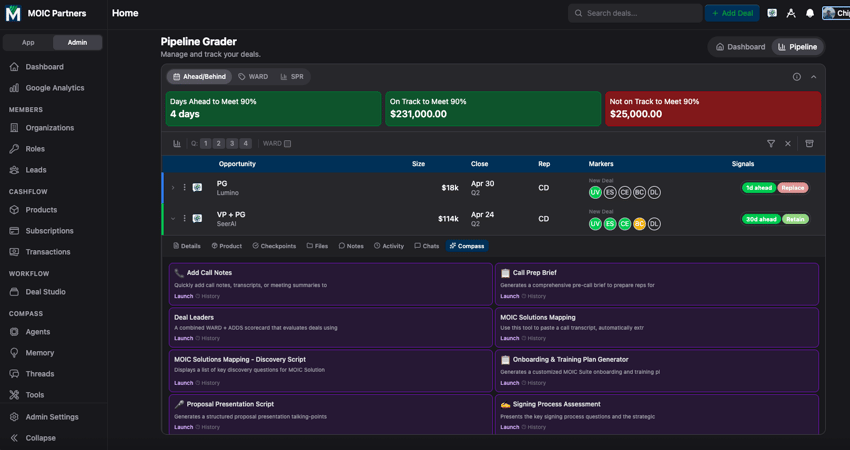
CRMs show you a deal is in "Stage 3." They won't tell you whether you've earned executive access or if you're 60 days in with no compelling event. The 5 markers fix that — and they follow a specific order, because each one earns the right to the next:
-
Unique Value — Something we do that is unique to us and valuable to the prospect
-
Executive Sponsor — Unique value earns access to the person whose budget is at stake
-
Compelling Event — Why now, and what happens if they don't act?
-
Business Case — Impact, economics, and success criteria validated with the prospect
-
Demo Last — Present last, confirm a decision — don't compete for one
Who's in Control?
Here's what makes MOIC fundamentally different: every feature in the platform is built around a single philosophy — determining who is in control of the deal, you or the prospect, and leveraging that understanding.
The 5 markers aren't just milestones. They're leverage checkpoints. Unique value gives you a reason to exist. Executive access gives you a seat at the table. A compelling event gives you urgency. A business case gives you pricing power. Demoing last gives you the final word.
MOIC doesn't ask "what stage is the deal in?" It asks "who has leverage, and what's the next move to take it back?"
Five Hours Compressed to Minutes
Building a business case. Mapping the signing process. Prepping a call brief. Running a deal scorecard. For a single deal, this work can consume five or more hours. Multiply that across 15 deals and the math breaks — reps either do the work and run fewer deals, or skip it and hope.
MOIC eliminates that tradeoff. AI-driven tools that already understand the deal context compress hours of strategic work into minutes. Business case builders, call prep briefs, solution mapping, proposal scripts, deal scorecards — generated from the data already in the system.
When five hours drops to three minutes, reps don't just work faster — they work more deals without sacrificing the rigor that wins.
She Didn't Leave HubSpot; she Outgrew It.
She still uses HubSpot every day. But she made a distinction most reps never make: there's a difference between managing information and managing a deal.
HubSpot manages her information. MOIC manages her wins.
If you want to turn your CRM data into deal-winning leverage, visit www.moicpartners.com to find out how we help teams execute the 5 markers in minutes.