
Why the deals you won’t kill may be costing you the most
Investors have a well-documented tendency to hold losing stocks too long. Behavioral finance calls it the disposition effect. Selling a losing position forces an investor to realize the loss. Holding it preserves the possibility that someday they might still be proven right.
Salespeople do exactly the same thing with pipeline.
Once a rep has invested discovery calls, demos, proposals, technical resources and executive attention into an opportunity, killing it becomes increasingly difficult. The larger the potential contract, the stronger the temptation to keep it alive. Maybe it will come back.
But keeping a bad deal in the pipeline doesn't preserve its value. It simply allows the deal to continue consuming something valuable: sales capacity.
A salesperson has finite capacity just as an investor has finite capital. Every hour invested in an opportunity that shouldn't survive qualification is an hour that cannot be invested somewhere better. That makes the speed of disqualification an economic variable.
Consider a salesperson working 15 opportunities per quarter. Historically, the rep might spend 10 hours on each of those losing opportunities before finally determining they aren't going anywhere. What if we could get it down to approximately three hours.
That seven-hour difference adds up quickly. Assuming a normal cut rate of 50% of 15 opportunities...a reduction from 10 hours to 3 hours to make that cut saves 52.5 hours per quarter, or 210 hours per rep per year. At a $100 loaded hourly cost, that's $21,000 of recovered capacity annually.
But that's only the lower limit of the business case.
The more interesting question is what happens when those hours are put back to work. The 210 recovered hours provide enough capacity to pursue approximately 21 additional opportunities per year, assuming 10 hours of selling capacity per opportunity. Apply the same 50% first cut, a 25% win rate after the cut, and a $35,000 average deal size, and that recovered capacity represents approximately $92,000 in incremental annual bookings capacity per rep.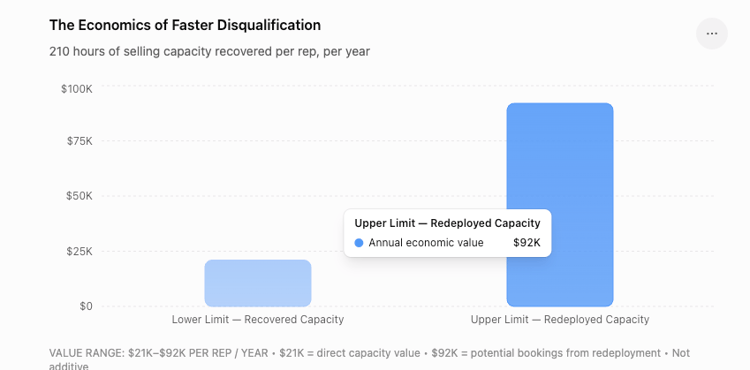
That gives us a useful range. The lower limit is $21,000 per rep per year, representing the direct economic value of the capacity recovered. The upper limit is approximately $92,000 per rep per year, representing what that same capacity can produce when successfully redeployed into additional opportunities. These aren't additive benefits; they are two different ways of valuing the same recovered capacity.
This is why Compass uses the business case as a disqualification test. If we cannot demonstrate measurable incremental revenue or a hard-dollar reduction in the customer's cost basis, tied to something uniquely ours, then we have to question why the customer would change at all. Without a compelling economic reason to change, there is probably no compelling event. Without a compelling event, there probably isn't a transaction.
This changes the fundamental question of pipeline management. Instead of continually asking, “What can we do to keep this deal moving?”, Compass asks, “Has this deal earned the right to consume another hour of our capacity?”
If the evidence says yes, invest aggressively. Build the business case, manufacture alignment and pursue the opportunity. If the evidence says no, realize the loss and redeploy the capacity.
That's where fast disqualification becomes operating leverage. Compass Reasoning helps eliminate weak opportunities earlier, while Compass Operations reduces the administrative burden surrounding the opportunities that remain. Together, they increase productive selling capacity without requiring additional headcount.
The analogy to investing is straightforward. Capital trapped in a losing investment cannot be deployed into a better one. Sales capacity trapped in a losing opportunity can't be deployed into a better deal either.
Having a losing opportunity isn't the mistake; holding onto it too long is.
Learn more at MOIC.