
Why slow organizational learning can cost far more than a missed quarter.
Enterprise sales organizations invest millions of dollars in products, people, technology, and process with one expectation: that those investments will appreciate through successful commercialization. Yet when organizations evaluate their commercial performance, they almost always focus on lagging indicators such as win rate, forecast accuracy, pipeline coverage, or sales cycle length. Those metrics describe outcomes, but they rarely explain why those outcomes occur. The more important question is whether the organization is learning fast enough to maximize the return on the capital already invested.
We recently observed a situation that illustrates the point: a well-qualified enterprise opportunity entered an internal IT review, and almost overnight the momentum disappeared. The champion returned with a simple explanation: "IT thinks they already have this covered. They believe they can build it themselves." At that point the opportunity had not been lost, but the champion no longer knew what to do. They could not determine whether IT represented a legitimate competitive threat, whether this was simply a predictable build-versus-buy buying pattern, or how to redirect the discussion. Like many sellers, they had reached the limit of their own experience.
Compass recognized the situation immediately.
Rather than treating the objection as unique, Compass identified it as a recurring buying pattern that appears repeatedly in enterprise software sales. More importantly, it explained why the objection had surfaced and prescribed the commercial reasoning necessary to respond. It equipped the champion to discuss total cost of ownership, long-term maintenance obligations, implementation risk, SLA accountability, and the hidden economics of internally developed software. Armed with that reasoning, the champion returned to the conversation prepared instead of surprised, and the opportunity resumed.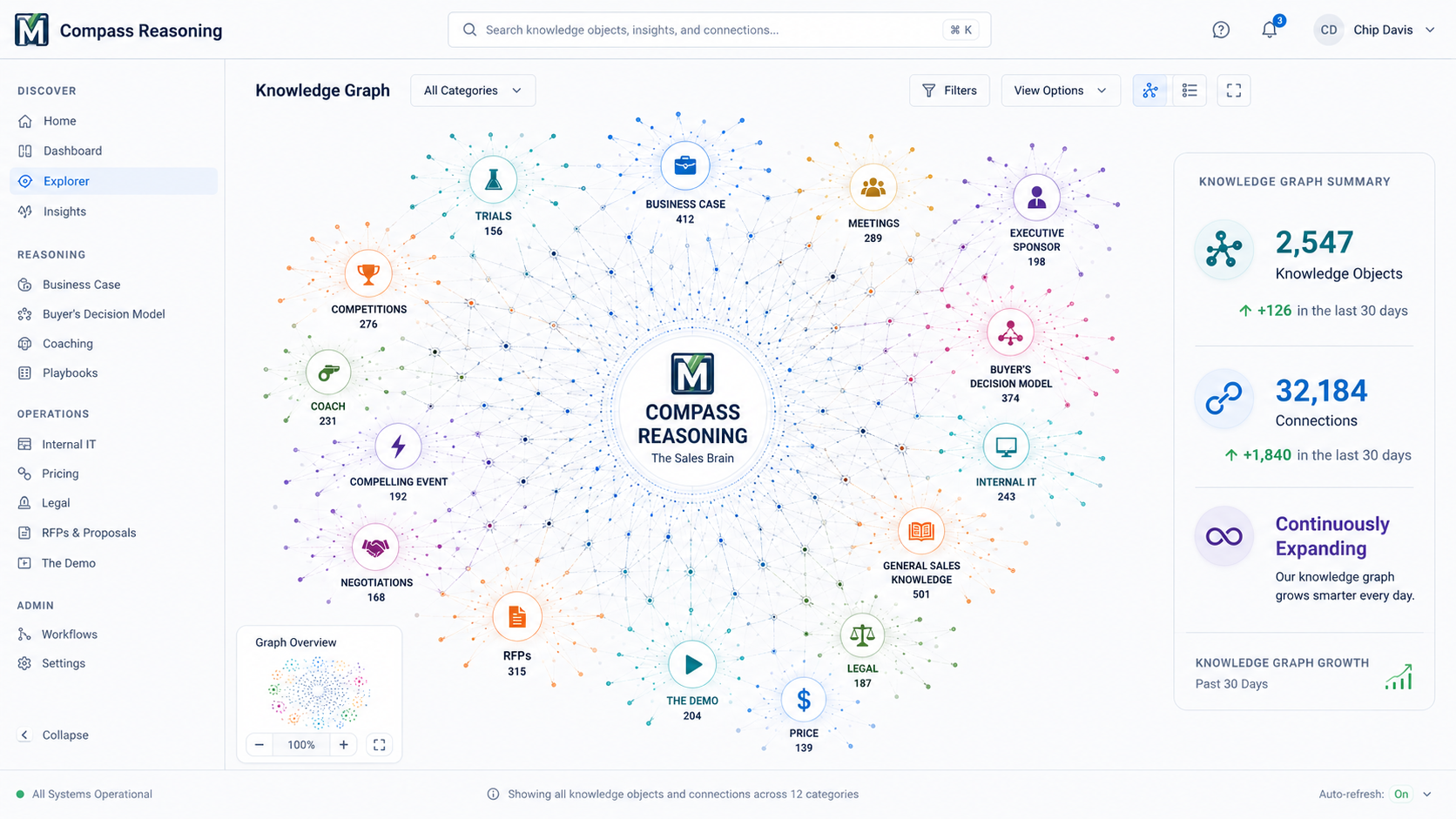
Most organizations would conclude that Compass shortened the sales cycle and while that is true, it is not the most important observation. The real significance is that the delay exposed a gap in organizational learning. The champion encountered a buying situation the organization should already have known how to navigate, yet the required reasoning had never been institutionalized. Instead, the organization was forced to learn the lesson again in real time, with a live customer, while an opportunity sat idle.
That is the enterprise sales learning curve.
Every avoidable delay is evidence that the organization is climbing that learning curve more slowly than it should. Knowledge remains trapped inside individual experience rather than becoming an organizational asset. The same buying patterns continue to surprise different sellers, the same objections require new discoveries, and the organization repeatedly pays tuition on lessons it has already purchased.
The consequence extends far beyond one delayed opportunity.
The sales organization is itself a capital asset. Assume a software company has invested $5 million building its commercial platform and expects that investment to generate a 30% annual return, or approximately $1.5 million of annual value creation. Further assume that 30% of that value—$450,000 annually—is attributable to commercialization. That equates to approximately $37,500 of expected commercialization value every month.
Every month an organization fails to climb its commercial learning curve, it may forfeit as much as $37,500 in expected commercialization value. That loss does not occur because the product is inferior or because the market disappeared. It occurs because organizational learning has not matured quickly enough to convert invested capital into commercial returns at the intended rate.
Viewed through this lens, a delayed opportunity is not merely a sales execution problem. It is observable evidence that capital is appreciating more slowly than investors require because the organization continues relearning commercial reasoning that should already have become institutional knowledge.
This is precisely the problem operational reasoning is designed to solve.
Rather than requiring every seller and every customer champion to acquire judgment through years of personal experience, Compass captures commercial reasoning, recognizes recurring buying patterns, explains why they occur, and delivers the appropriate response precisely when it is needed. Lessons learned once become lessons available to everyone. The organization no longer depends upon individual memory; it develops institutional intelligence.
Organizations that institutionalize commercial reasoning climb the learning curve faster. Faster learning accelerates commercialization. Faster commercialization accelerates capital appreciation. Ultimately, the greatest competitive advantage is not simply winning more opportunities—it is increasing the rate at which the organization learns, because the speed of learning ultimately determines the speed at which invested capital creates enterprise value.
Learn how Compass helps sales organizations accelerate commercial learning at moicpartners.com .