
It Isn’t an Art—It’s a Sequence
Strategic selling is often described as something elusive—a higher-order capability reserved for complex deals and senior sellers. It’s framed as an art form, powered by intuition, experience, and instinct. But when you remove the mystique, strategic selling becomes far more concrete.
At its core, strategic selling is a series of transactions—each one a discrete exchange between buyer and seller with a clear outcome. A commitment is made. Access is granted. Risk is reduced. Value is clarified.
The difference between transactional and strategic selling is not one of kind, but of accumulation and sequence. A transactional sale is a single event. A strategic sale is a disciplined progression of transactional events over time.
Five Transactions That Define a Strategic Sale
Strategic selling can be thought of as five explicit transactions generally completed in order. Each creates the conditions necessary for the next. Skip one, and the reliability of everything that follows is diminished. So what are these transactions?
- Is my product unique? - Uniqueness in exchange for acknowledgment. The seller must establish the product is meaningfully different in a way that matters to the prospect and the buyer must acknowledge the uniqueness. Without uniqueness, every subsequent step is fragile.
- Is my product unique in a way that earns access to the Executive Sponsor? - Uniqueness then earns access to the Executive Sponsor. If the value does not resonate at the executive level, the sale is, by definition, not strategic.
- Is the Executive Sponsor willing to tell me why now? - This transaction confirms urgency. Strategic deals are anchored to time-bound drivers—events, risks, or opportunities that demand action. Without a clear “why now,” momentum is illusory.
- Will the prospect negotiate the business case with us? - This is where value is formalized. Negotiating the business case is not about price—it is about mutual agreement on impact, economics, and success criteria. If the prospect will not engage here, alignment does not exist.
- Will the prospect allow us to demo last? - This final transaction is diagnostic. Demoing last signals that the prospect is now oriented around outcomes, not features. The demo becomes confirmation, not persuasion.
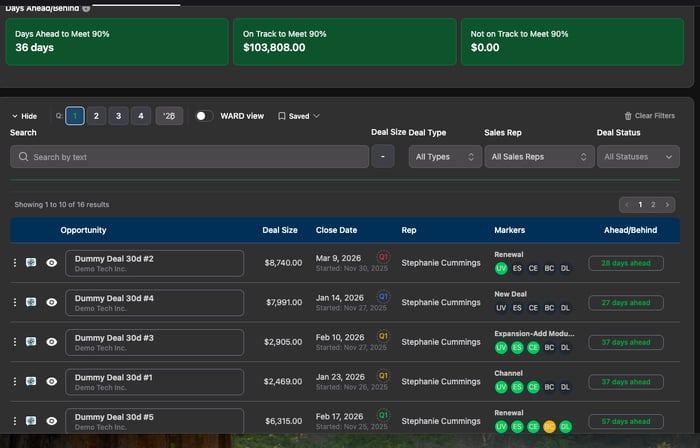
Each of these questions represents a transaction with a binary outcome. A “no” does not mean failure; it means the sale has not earned the right to advance. Click the image below to see how Pipeline Grader guides you through each transaction.
Why the Business Case Matters
One of the few genuine distinctions between transactional and strategic selling is the necessity of a business case. Transactional sales rarely require one. The buyer can justify the decision personally, the risk is limited, and the value is immediately apparent.
Strategic sales require justification that survives scrutiny across the organization. The business case is the transaction where value is quantified, defended, and internalized. Critically, the business case is not created in isolation. It is the cumulative output of the earlier transactions—uniqueness, executive access, urgency, and alignment. When those transactions are incomplete, the business case is thin. When they are complete, the business case becomes inevitable.
Strategic Selling, Demystified
This framework removes abstraction from strategic selling. It does not rely on charisma or intuition. It relies on sequence. Each transaction can be executed using fundamentally transactional skills: asking precise questions, earning incremental commitments, and respecting the buyer’s decision process. Strategic selling is not a different skill set. It is a different operating model.
The Real Stretch
The challenge is not understanding the transactions. The challenge is discipline. It is whether sales teams can resist skipping steps, mistaking enthusiasm for commitment, or allowing pressure to compress timeframes that should not be compressed. Strategic selling succeeds not because it is complex, but because it enforces order. And order—unlike mysticism—can be taught, measured, and enforced.
Strategic selling is a sequence of earned transactions, and your pipeline should reflect that reality. Pipeline Grader evaluates deals based on objective evidence—not optimism—so you can enforce order and predict outcomes. Learn more at www.moicpartners.com.