
Enterprise customer relationships can unlock millions in acquisition value—without adding a dollar of revenue.
Strategic acquirers don't buy revenue; they buy market position, account control, and the opportunity to sell more into customers they don't already own. An enterprise customer relationship can be worth substantially more to a strategic acquirer than to the company that originally established it. The acquirer brings a broader product portfolio, greater distribution, and the ability to monetize that relationship across multiple offerings. What represents $1 million in revenue to the seller may represent several times that opportunity to the buyer. Small-customer revenue rarely provides the same strategic leverage. This is why moving upmarket can change not just who might acquire your company, but what they are willing to pay for it.
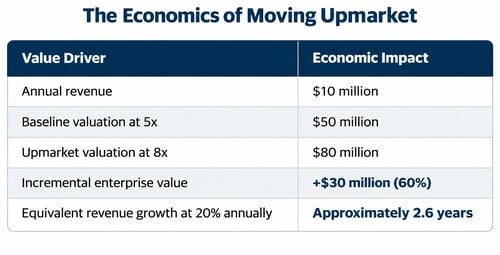
The valuation implications are substantial. A company generating $10 million in revenue at a 5x multiple is worth $50 million. At 8x, the same company is worth $80 million. That's a 60% increase in enterprise value without adding a dollar of revenue. At 20% annual growth, it would take approximately 2.6 years to create equivalent value through revenue growth alone, assuming the original multiple holds. The difference is not simply growth potential. It is strategic relevance.
But strategic relevance must be earned. Product-led growth can create awareness, adoption, and a broad base of customers, but it does not necessarily establish control of enterprise accounts. That requires a fundamentally different sales motion: navigating complex buying committees, establishing executive relationships, quantifying business value, and building durable commercial relationships that competitors cannot easily displace. Founders seeking a strategic acquisition premium must deliberately target enterprise accounts and build the capabilities to win, retain, and expand them.
The takeaway: A financial buyer primarily values the cash flows your company can generate. A strategic buyer can also value the incremental cash flows your customer relationships make possible for their business. Moving upmarket creates the opportunity to capture that strategic premium. The objective isn't simply to become a larger company. It's to become a company that is worth more in someone else's hands than in your own.
The strongest distinction is in that last sentence. It explains the economic rationale for a strategic acquisition rather than merely arguing that enterprise revenue deserves a higher multiple. The 5x-to-8x illustration then demonstrates the potential value of that distinction, rather than treating the premium as automatic.
Moving upmarket isn't simply a sales strategy. It's a value creation strategy. Compass by MOIC helps companies build the enterprise sales discipline, execution capabilities, and predictable revenue performance that make strategic growth possible. Explore how Compass can accelerate your upmarket strategy.