
In the end, it's about the money.
Product-market fit in enterprise software actually happens at two levels — technical and financial — owned by two completely different buyers. Most sales teams treat them the same way, and it costs them deals.
The technical buyer (your champion) evaluates whether the software can do the job. The economic buyer (typically the CFO) evaluates whether the financial logic holds. A champion who's enthusiastic but can't articulate a defensible ROI to the CFO is a champion who loses the internal vote. Deals don't stall because the demo failed — they stall because the business case was missing or weak.
The numbers make this concrete: a collaboratively built business case — co-authored with your champion — can lift close probability from 60% to 90%. For a company doing $5M in software revenue with a 25% loss rate, recovering even half of those deals is worth $625K in revenue and over $3M in enterprise value at a 5x multiple.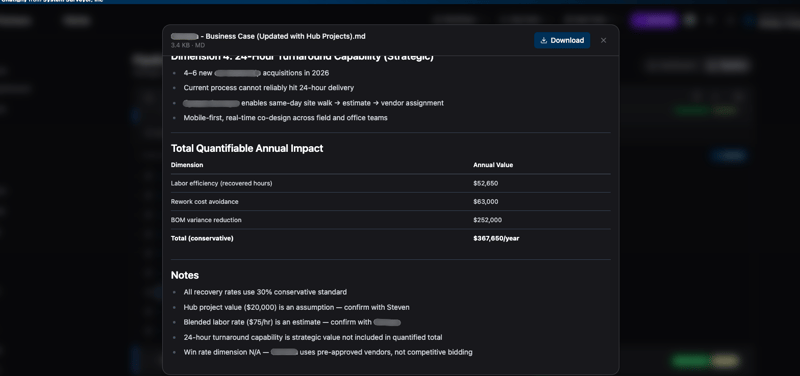
That's the premise behind the Business Case Method in MOIC Pipeline Grader — a structured process that bridges technical conviction and financial conviction early in the cycle, giving your champion a document they'll actively defend internally. Technical fit is table stakes; financial fit gets the CFO to sign.