Institutionalizing sales knowledge can accelerate productivity, reduce turnover, and recover significant economic value.
Regardless of the technology era—client/server, SaaS or the emerging AI era—the three most critical non-revenue-oriented issues for any sales leader remain the same: recruiting the right people, ramping them up quickly and retaining them.
The economic value of each is compelling. Packaged together, the opportunity cost of failure is enormous.
Consider that hiring an enterprise software salesperson can represent an 18-month commitment: six months to recruit, six months to ramp up and potentially another six months to exit an under performer. At a $150,000 annual salary, that represents up to $225,000 in salary over 18 months, before benefits and lost productivity.
Accelerating ramp-up and improving retention offer the greatest opportunity. Successful salespeople tend to stay longer, and the faster they become productive, the greater the return on the company's investment.
The Economics of a 10-Person Sales Organization
What happens when turnover declines to 10% and ramp-up falls to two months?
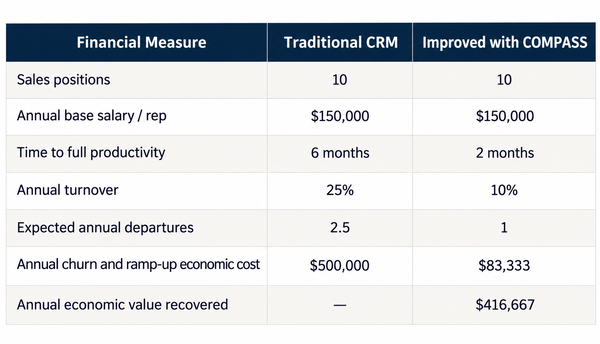
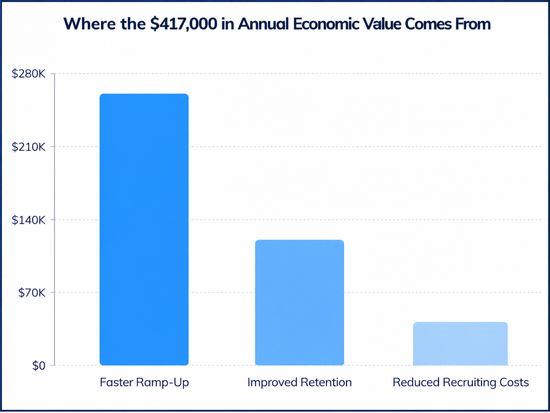
The result is nearly $417,000 in annual economic value, equivalent to approximately 28% of the organization's annual base salary investment—without adding a single sales position.
Institutionalizing Sales Knowledge Changes the Equation
Traditional CRM systems have largely failed to address these issues because they are primarily scorekeepers and custodians of customer data. They lack a point of view on how to execute a successful enterprise sale.
COMPASS by MOIC combines AI with the Business Case Method to institutionalize sales knowledge and automate critical elements of sales execution. From opportunity qualification to business case development and proposal generation, COMPASS reduces the work required of salespeople while giving them access to proven enterprise sales methods.
In practical terms, COMPASS helps turn C students into A students, making them successful faster and increasing the likelihood they remain successful longer.
The principle is simple: When experienced salespeople leave, their knowledge shouldn't leave with them. And when new salespeople arrive, they shouldn't have to spend six months learning what the company already knows.
Recruiting gets people in the door. Ramp-up determines how quickly they contribute. Retention determines how long the company benefits.
COMPASS makes sales success less dependent on individual experience and more dependent on a repeatable, institutionalized method. The result is a sales organization that gets better with every hire, rather than starting over with every departure. Learn how COMPASS by MOIC can help your organization achieve the same at moicpartners.com.