
Quiet deals often hide risk. Here's why triangulating your sources matters.
The old adage about news is as true today as it has ever been: good news isn’t really news at all, because if it’s good, you probably already know it. On the flip side, no news is bad news for precisely the opposite reason. And bad news can actually be good news, because at least knowing about a problem gives you the opportunity to do something about it.
Part of the issue revolves around our source for news. Do we rely on our coach, the decision maker, or the CIO, or do we triangulate news across the three likely sources?
Too often we rely on our coach, who has convinced us that he/she has the full support of the executive team as well as IT support. Unfortunately, their enthusiasm notwithstanding, their ability to make a deal happen is highly suspect.
No third party (including our coach) can sell our products as effectively as we can. So why would we trust our coach, who may have his/her own agenda, to close our deal?
Further, how do we keep from outsourcing our selling to our enthusiastic coach, who will often disappoint us?
First and foremost, leveraging COMPASS requires the sales rep to get confirmation from the decision maker on the validity of the business case (driven by our unique capabilities) as well as confirmation of the deal timing (why now, and what happens if you don’t). Our coach often cannot answer these questions accurately.
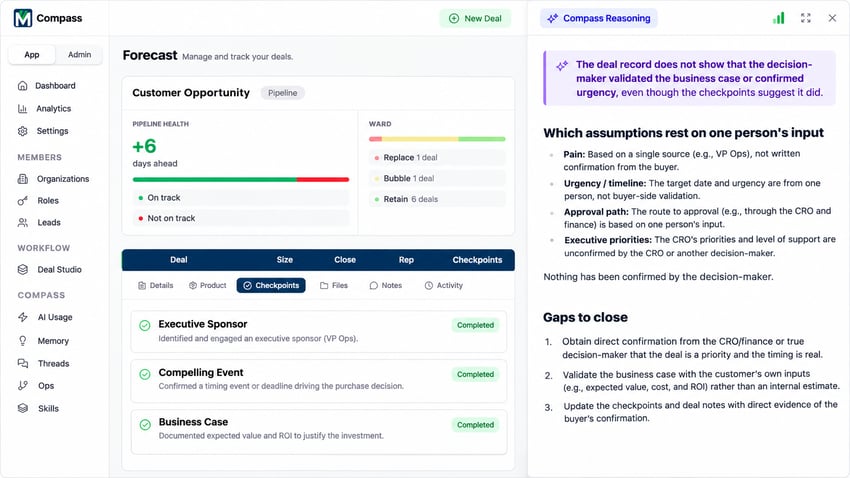
Compass identifies the gap between completed sales checkpoints and verified decision-maker commitment, exposing risks that might otherwise go unnoticed.
Ultimately, we need to ensure that we triangulate all relevant facts across our coach, IT and the decision maker to ensure accuracy. If your coach blocks you from IT and/or the decision maker, you should understand that your opportunity is not likely happening.
If your sales team struggles to leverage the right news sources during a sales cycle, log into COMPASS at www.moicpartners.com.