Your AI Isn't the Problem — Your Context Is
Why the most powerful sales organizations aren't just using AI — they're imprinting it.
Everyone agrees that AI is changing how businesses operate. The tools are faster, the models are smarter, and the outputs are increasingly impressive. This is not a controversial observation; virtually every sales leader, CRO, and CEO has accepted it as fact.
But here's what most of them are missing: the engine is not the edge.
The Gym Analogy Nobody Talks About
Think about a world-class athletic training facility. The equipment is identical for every member — same weights, same machines, same track. Two athletes walk in. One is a seasoned Olympian with decades of muscle memory, sport-specific technique, and a coach who knows every weakness. The other is a motivated beginner with a generic workout plan pulled from the internet.
Same gym. Radically different outcomes.
This is exactly what's happening with AI adoption in enterprise sales today. Companies plug into the same foundational models — OpenAI, Anthropic, others — and assume the power is in the engine — it isn't. The power is in what you bring to it.
Context is the gym coach. And most organizations don't have one.
The Hidden Lever: Institutional Memory
Here's the factor that separates the top 10% of AI-powered sales organizations from everyone else: they have figured out how to store, retrieve, and compound organizational understanding.
It's not prompt engineering. It's not model selection. It's not even data hygiene.
It's the ability to take a reasoning event — a call transcript, a competitive insight, a hard-won discovery from a lost deal — and make it permanently available to every person in the organization, forever.
Most companies can't do this. Their best thinking evaporates when a rep leaves. Their call transcripts sit in a folder no one opens. Their institutional knowledge lives in the heads of three rainmakers who are one recruiter call away from walking out the door.
The result? Every new rep starts from zero. Every deal reinvents the wheel. Every insight dies with the quarter.
What That Costs You — In Dollars
The financial stakes here are not abstract.
Consider the math: a new enterprise sales rep takes six months or more to ramp. During that window, they are running suboptimal discovery, missing competitive signals, and misreading buying behavior — not because they lack talent, but because they lack accumulated context.
Compress that ramp from six months to near-immediate and you've recovered a meaningful percentage of annual quota attainment per rep. Multiply that across a team of ten, and you're looking at millions in recovered revenue — from a knowledge problem, not a headcount problem.
And it compounds in the other direction, too. When institutional understanding accumulates — when every call, every win, every loss becomes part of a living knowledge base — forecast accuracy improves. Deal qualification sharpens. Win rates climb. The MOIC framework has observed forecast accuracy move from the industry-standard 10–13% to north of 90% when the right intelligence infrastructure is in place.
That's not a marginal gain. That's a structural advantage.
Compass: The Mechanism for Imprinting Intelligence
This is precisely the problem that Compass inside Pipeline Grader is designed to solve.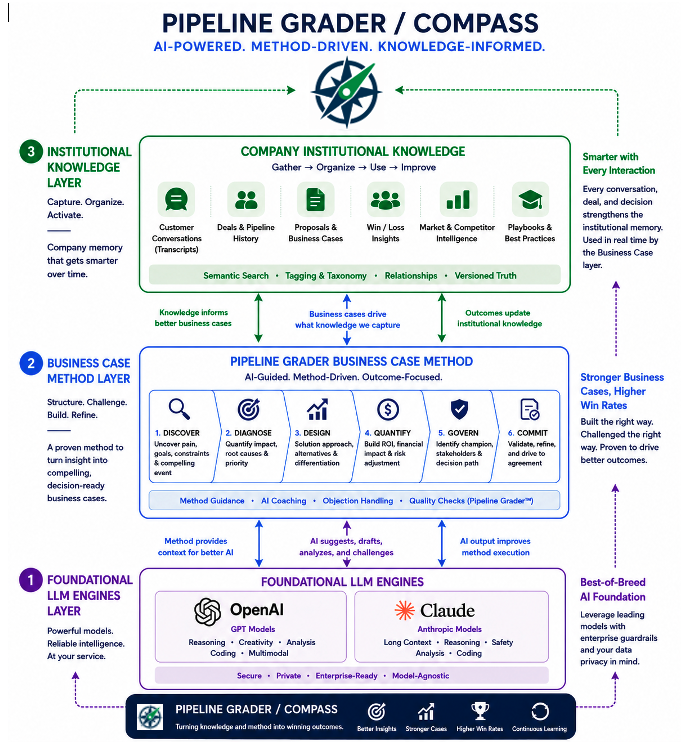
Compass doesn't just connect to a powerful AI engine — it connects that engine to a purpose-built knowledge base comprised of call transcripts, competitive data, product intelligence, deal history, and 80+ years of enterprise sales pattern recognition. When a user drops a document into Compass and it performs an analysis, that analysis doesn't disappear. It becomes part of the organization's institutional memory — available to every user, in every future interaction, whether they know it or not.
This is what it means to imprint understanding on an organization.
The analogy is precise: you are not just teaching the AI. You are teaching the organization. Every reasoning event — every insight surfaced, every objection handled, every business case constructed — becomes a permanent asset. New reps inherit it. Experienced reps build on it. The system gets smarter with every interaction.
Anthropic's models, which power Compass's large-context reasoning, are particularly well-suited to this task — handling the kind of rich, nuanced, multi-document analysis that enterprise sales demands. But the model is still just the gym. Compass is the coach who knows your history.
The Question Worth Asking
If your team closed a deal last quarter using a perfectly crafted business case, a sharp competitive displacement argument, and a compelling event that moved a stuck prospect to action — does your newest hire have access to any of that?
If the answer is no, you don't have an AI problem; you have a context problem. And it's costing you more than you think.
Explore what Compass can do for your organization at www.moicpartners.com.